
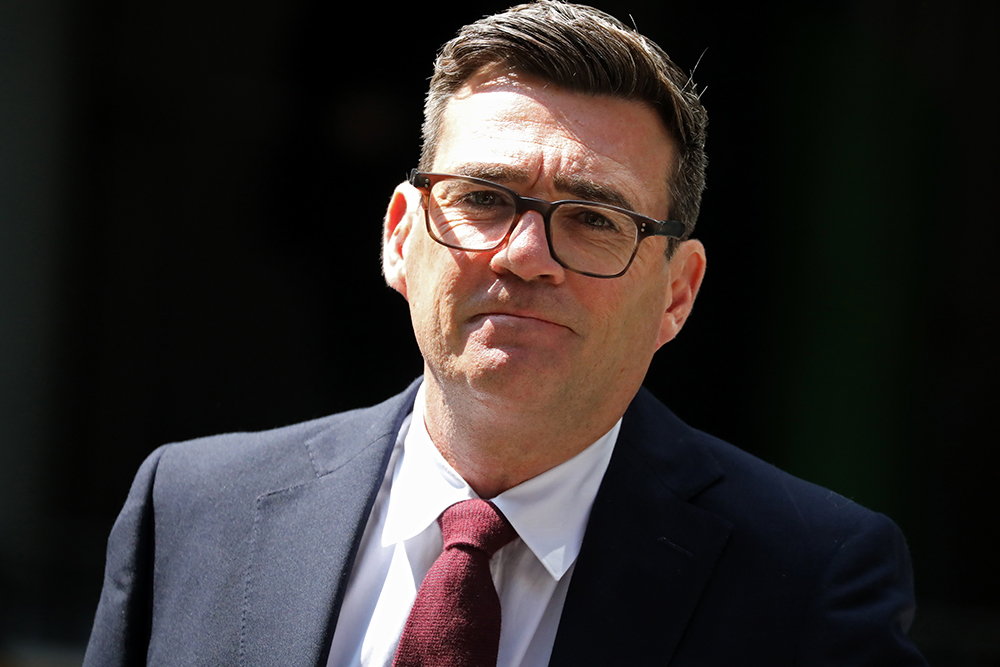
Today, the United Kingdom has ushered in a new leader. Andy Burnham has taken over from Keir Starmer as the country’s seventh prime minister since 2016.
Burnham’s enthronement followed Starmer’s resignation and his meeting with King Charles III at Buckingham Palace. During his audience with Charles, Burnham became prime minister and was invited to form a government in His Majesty’s name.
Who is Andy Burnham?
Born: 7 Jan 1970 (56 years), Old Roan, United Kingdom
Spouse: Marie-France van Heel (m. 2000)
Parents: Roy Burnham, Eileen Burnham
Education: Fitzwilliam College, University of Cambridge
Party: Labour Party
Previous offices: Mayor of Greater Manchester (2017–2026)
TV shows: Farewell Your Majesty (Since 2023), Manchester: A Year of Hate Crime (Since 2018)
Office: Member of Parliament of the United Kingdom
Burnham may not be well-known abroad, but the newly chosen Labour Party leader is quite popular at home.
England’s north-south class divide shaped his politics. Born and raised in northern England, Burnham moved to the generally more posh south to study English literature at the University of Cambridge, where one professor recalls him wearing a soccer jersey to class.
“I think that might be quite common on the streets of northwest England, but it’s not necessarily a common thing in a Cambridge college,” Professor John Mullan told the Times of London. He recalled the young Burnham as a soccer-obsessed lad who recited Shakespeare and dated “the coolest girl in the college.” She is Dutch-born Marie-France van Heel, and the couple are now married.
The soccer jersey was an early example of the working-class identity that would later define Burnham in politics.
Burnham, 56, often highlights his northern, blue-collar roots. Analysts say his upbringing and his time as mayor of Greater Manchester — which prides itself as the world’s birthplace of the working class, during the Industrial Revolution — have shaped his national policies. That background could also help his centre-left Labour Party win back working-class voters, some of whom have shifted to voting for right-wing parties in recent years.
“I want to do whatever I can to make Labour a party that [people] can believe in again, a party that’s solidly on the side of working-class people,” Burnham told the U.K.’s Channel 4 News in May.
Early on, Burnham fought stereotypes of northern soccer fans.
Born in a suburb of Liverpool to parents who worked as a telephone engineer and a receptionist, Burnham was raised in a village about halfway between there and Manchester. After graduating from Cambridge, he and van Heel stayed south, moving to London. Burnham was first elected to Parliament at age 31, with Labour, representing a northern district.
He served as secretary of state for culture, media and sports under Prime Minister Gordon Brown, and in 2009, was sent to Liverpool to give a speech on the anniversary of the 1989 Hillsborough disaster, when nearly 100 soccer fans were crushed to death in an overcrowded stadium in northern England. It was the deadliest sports accident in British history. But the victims were labeled as hooligans, and many survivors and victims’ families felt the government had not done enough to investigate. Initially, the crowd heckled Burnham. Fighting back tears, he abandoned his prepared remarks, nodding his head as the crowd chanted for justice.
“They were treated so badly, and [Burnham] was one of the first politicians to really listen,” says Charlotte Wildman, a University of Manchester historian who studies the working class.
Burnham launched a government inquiry that found police failures, not the victims themselves, were responsible for the disaster. That helped change a national stereotype, Wildman says.
“Particularly northern, working-class men were demonized. They were accused of being violent, aggressive, criminal, and that was a very entrenched stereotype,” she says.
It’s a demographic in which some feel left behind by globalization, ignored by politicians in the more affluent south, where London is — and which Burnham won over early, with his Hillsborough advocacy.
As a member of Parliament, Burnham ran twice for the Labour leadership. In 2015, he was nominated by his fellow lawmaker and friend, Keir Starmer. But he lost both times and ultimately quit Parliament after 16 years, to return north. In 2017, he was elected mayor of Greater Manchester — where, in local politics, he built a national reputation.
In the 1980s and ’90s, Manchester was known for two things: post-industrial blight, and a vibrant indie music scene (with bands like The Smiths, New Order, The Stone Roses and Oasis). Burnham set out to fix the former, and immerse himself in the latter.
Redevelopment was already underway in Manchester when Burnham took office, and he doubled those efforts, seeking to change the stereotype of his city, in the same way he’d done for soccer fans. He took control of city buses, and convinced the central government to devolve more powers over education and housing to cities like his.
“Regeneration, it was almost like marketing and branding!” Wildman notes. “Manchester used to have such a negative image. It was so associated with urban decay.”
Prime Minister Burnham is likely to face many of the same challenges that hurt Starmer: low national growth, high energy prices, pressure to ramp up defence spending, amid Russia’s ongoing war in Ukraine — and a certain volatile ally across the Atlantic.
Herrmann says he’s not sure how Burnham will weather those.
“Andy Burnham is someone who really likes to have affirmation. I don’t know what lengths he’ll go to to make sure Donald Trump isn’t truth-socialing about him in [the] middle of the night, because he won’t like that,” Herrmann says. “He will be more hurt by that, I think, than someone like Keir Starmer.”
Governing a country rather than a city, he says, is something Britain’s new prime minister will quickly have to get used to.
— With NPR.ORG and agency reports