
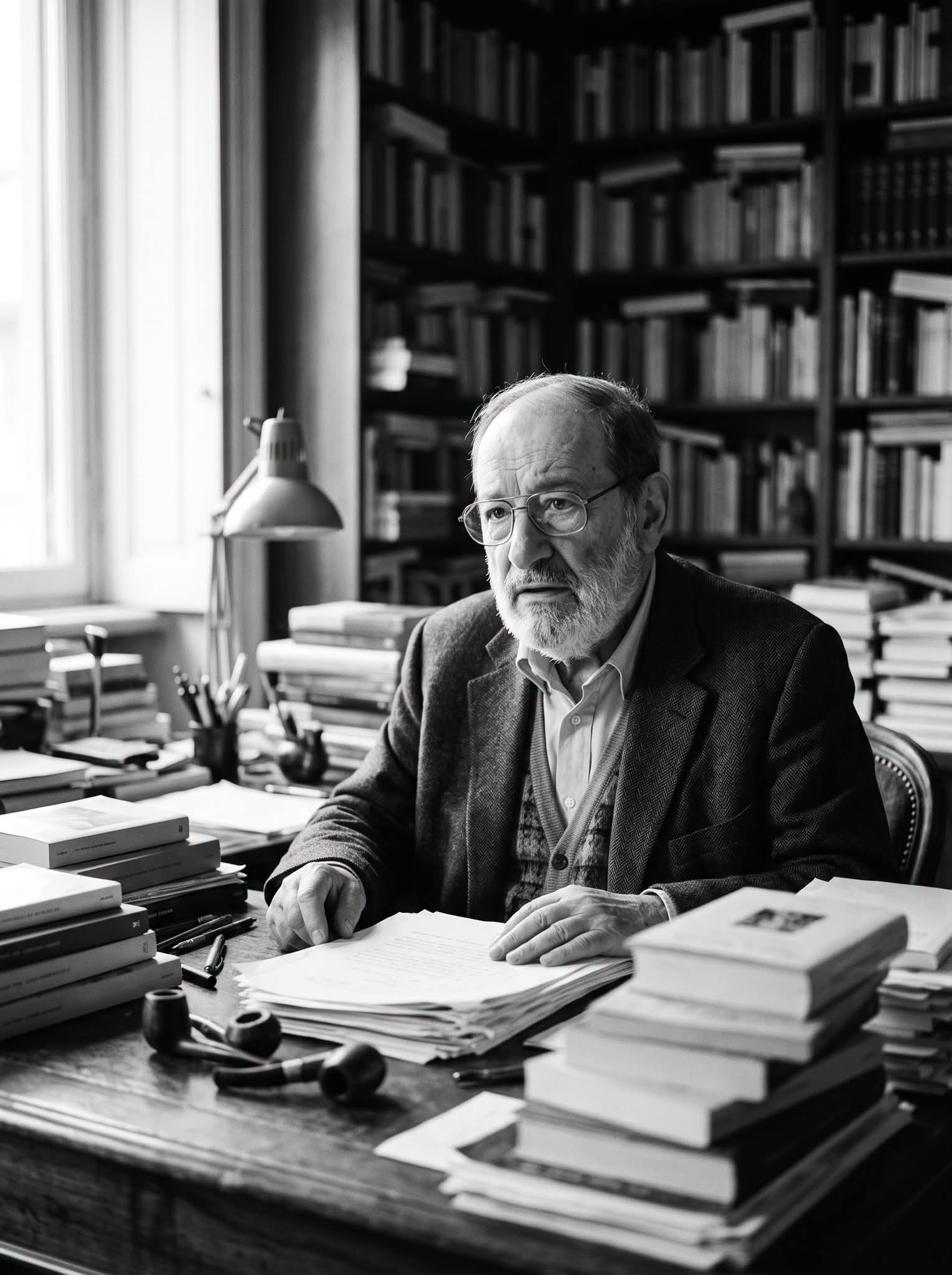
In 2015, an 83-year-old Italian philosopher predicted exactly what would destroy rational discourse. We’re living in the world he warned us about.
Umberto Eco [pictured] spent his life studying how humans communicate.
He was a medieval scholar, a semiotician who decoded signs and symbols, and the author of The Name of the Rose — an intellectual thriller that became a global phenomenon. He understood how ideas spread, how language shapes reality, how societies decide what counts as truth.
So when social media exploded across the world, Eco watched with growing alarm.
In June 2015, during an interview in Italy, the 83-year-old philosopher said something that would become eerily prophetic. He was asked about the internet’s impact on society.
His response was blunt: “Social media gives legions of idiots the right to speak when they once only spoke at a bar after a glass of wine, without harming the community. They were quickly silenced, but now they have the same right to speak as a Nobel Prize winner. It’s the invasion of the idiots.”
The words sparked immediate controversy. Critics accused him of elitism, of wanting to silence ordinary voices, of being an old man who didn’t understand democracy.
But that wasn’t what Eco was saying at all. He wasn’t arguing that people shouldn’t have free speech. He was warning about what happens when expertise becomes worthless—when a scientist’s decades of research carries the same weight as a stranger’s gut feeling.
For centuries, public discourse had gatekeepers. Newspapers had editors. Publishers had fact-checkers. Universities had peer review. These weren’t perfect systems—they excluded voices that deserved to be heard and protected power structures that needed challenging.
But they also created accountability. If you wanted to publish a medical claim, you needed evidence. If you wanted to influence public opinion, you needed credibility. If you spread lies, there were consequences.
The internet changed everything. Suddenly, anyone could broadcast to millions. A teenager in their bedroom had the same platform as a tenured professor. A conspiracy theorist had the same reach as a journalist who’d spent months investigating.
And crucially: the most extreme voices often travelled fastest. Because social media algorithms don’t reward truth. They reward engagement. And nothing engages like outrage, fear, and certainty. A measured, nuanced post saying “this issue is complicated and requires careful thought” gets ignored. A post screaming “THEY’RE LYING TO YOU” gets shared ten thousand times.
Eco saw this happening in real time. He watched as flat-earthers found each other and built movements. As anti-vaccine conspiracy theories spread faster than actual public health information. As political lies that could be debunked in thirty seconds became “alternative facts” shared by millions.
He watched expertise die.
Climate scientists with PhDs and decades of research were “debated” by bloggers who’d watched three YouTube videos. Doctors were contradicted by wellness influencers selling supplements. Historians were drowned out by people who’d “done their own research.” And the phrase “do your own research” became code for “reject expertise in favor of whatever confirms what you already believe.”
Eco understood something crucial: giving everyone a voice is beautiful. But treating every voice as equally authoritative is dangerous. Your uncle’s Facebook post about vaccines is not the same as a peer-reviewed medical study. A viral tweet claiming election fraud is not the same as official electoral data. An influencer’s opinion on climate change is not the same as NASA’s scientific consensus.
But on social media they look the same. They appear side by side in your feed with equal visual weight, equal algorithmic promotion.
The platform doesn’t say: “This is from an expert with credentials. This is from someone with no relevant knowledge.” It just says: “Here are some posts. Good luck figuring out which ones are true.” Eco called this the “invasion of the idiots”—not because ordinary people are idiots, but because platforms gave megaphones to the loudest, most confident voices regardless of whether they knew anything.
And confidence, it turns out, is more viral than accuracy.
Nine months after that interview, in February 2016, Umberto Eco died at age 84. He didn’t live to see how right he was. He didn’t see a global pandemic where medical misinformation spread faster than the virus itself, killing people who believed Facebook posts over doctors. He didn’t see millions of people convinced that election results were fraudulent based on viral lies that had been debunked dozens of times. He didn’t see artificial intelligence making it possible to create fake videos indistinguishable from reality, or bots that could flood platforms with propaganda.
But he predicted the core problem: when every opinion has equal authority, truth becomes just another opinion.
Eco’s warning wasn’t about silencing people. It was about rebuilding respect for expertise, for evidence, for the hard work of actually knowing things.
It was about recognizing that while everyone has the right to speak, not every claim deserves to be believed. That a PhD in epidemiology means something. That peer-reviewed research means something. That journalistic standards mean something. And that “I saw it on social media” should never be where critical thinking ends.
Before he died, Eco said something else that’s worth remembering: “The real hero is always a hero by mistake… he dreams of being an honest coward like everyone else.”
In our current moment, being intellectually honest—admitting uncertainty, seeking expertise, changing your mind when presented with evidence—takes courage. Because platforms reward certainty. Algorithms promote outrage. Engagement goes to whoever shouts loudest.
Being careful, thoughtful, and humble about what you actually know? That’s become a revolutionary act.
Umberto Eco spent his life studying how societies create and share meaning. He watched the internet transform communication in ways that terrified him.
Not because people were speaking, but because truth was drowning in noise. His warning in 2015 wasn’t cynicism. It was love—for knowledge, for discourse, for the possibility of understanding each other through reason rather than tribalism.
We’re living in the world he feared. The idiots didn’t invade—they were always here. The problem is that now their voices are amplified while expertise is dismissed.
The question Eco left us with is simple: What are we going to do about it?
— Philosophy Fuse/Facebook